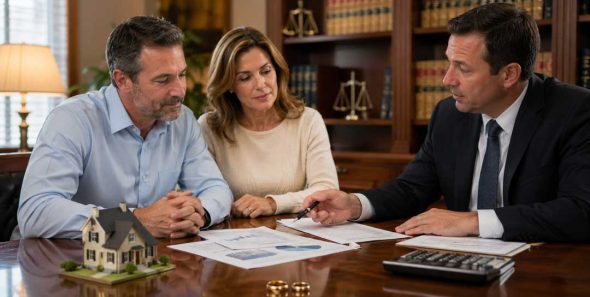
Going through a divorce in Shreveport raises questions about how property is split, even when both parties agree on most terms. Louisiana law treats property you acquire and debts you incur during marriage as community property. An uncontested divorce can speed up the process, but it does not remove the need for clear legal steps or thoughtful decisions.
When you work with local counsel, you can better understand your rights and reduce the risk of conflict or unexpected issues involving your finances or your home. At our firm, we regularly guide individuals through uncontested divorce in Shreveport, helping them stay grounded in Louisiana law while moving forward with clarity. The way courts approach an equal division of marital property begins with these basic rules.
Equal Split of Marital Assets
Louisiana law treats most assets acquired during marriage as marital property, which is generally divided equally between both spouses in a divorce. This community property framework means that assets such as homes, vehicles, retirement accounts like 401(k)s, and joint bank accounts are typically divided 50/50.
Under Louisiana Civil Code Article 2336, this division applies even if only one spouse earned the income or purchased certain assets during the marriage. Property owned before the marriage usually remains separate unless it has been combined with community funds or retitled in both spouses’ names.
Benefits such as pensions and deferred compensation may also be divided if they were earned during the marriage. In uncontested divorce matters handled at the Law Offices of Mark D. Frederick, LLC, we help clarify what qualifies as community property and how it may be addressed.
We assist with preparing and reviewing documentation related to shared assets under Louisiana family law. This process helps ensure each step aligns with state requirements while avoiding unnecessary disputes over property division.
Classifying Separate vs. Community Property
Property division in Louisiana depends on the legal distinction between separate and community property. Understanding these differences helps you identify which assets may be subject to division during a divorce.
- Separate Property: Assets owned before the marriage generally remain separate. Property brought into the marriage by either spouse is typically considered that individual’s own under Louisiana law.
- Community Property Presumption: Most property acquired during the marriage is presumed to be shared. Louisiana law assumes that anything gained during the marriage belongs to both spouses unless a legal exception applies under Civil Code Article 2338.
- Gifts and Inheritances Exception: Gifts or inheritances received by one spouse remain that person’s separate property. This applies even if the marriage lasted many years, provided the asset was not mixed with community property.
- Matrimonial Agreements: Legal agreements can define certain assets as separate. Prenuptial and postnuptial agreements allow spouses to determine in advance how specific property will be treated.
- Judicial Partition Option After Divorce: When spouses cannot agree on classification, the court may step in. A judicial partition allows the court to review the evidence and make a final determination under Louisiana law.
Legal Steps in Property Division
Once the property has been identified as separate or community, the next step involves creating a detailed list of all assets and debts. Louisiana law requires both spouses to submit a sworn descriptive list outlining community property, including estimated values and any outstanding obligations.
If there is disagreement about the value or classification of an item, either party may file a traverse to challenge the other’s list. In some cases, professional evaluations may be needed to determine accurate values, especially for complex assets. Spouses are encouraged to negotiate and reach agreements whenever possible. This approach often reduces stress and enables a more efficient resolution than litigation. Even in an uncontested divorce, any agreement must still be reviewed and approved by the court before it becomes final.
Choosing an uncontested divorce can provide a more straightforward path, especially when both parties are willing to work together on property division. At the Law Offices of Mark D. Frederick, LLC, we help individuals and families in Shreveport and surrounding communities understand their options and take practical steps forward.
If you have questions about your rights or need guidance tailored to your situation, we are here to provide clear, honest support as you move through the divorce process under Louisiana law.
Once separate and community property have been identified, the next step is listing all assets and debts for division. Louisiana law (La. 2338, 2341) requires both spouses to prepare a sworn list showing each item of community property, including its fair market value and remaining debt amounts, for review by the court.
If you disagree with an item’s value or its place on your spouse’s list, you can file a “traverse.” You may need help from appraisers or financial advisors when you value complex items. You can choose to talk and negotiate with your spouse about how everything should be split.
You can do this instead of letting a judge make those decisions in a trial, a process courts encourage as it often speeds things up for everyone involved. Any agreement between the two of you still requires final court approval under § 9:2801(A)(1), (2) before it becomes official.
Choosing an uncontested divorce in Shreveport can bring clarity and less stress, especially when it comes to splitting property. With a clear grasp of Louisiana’s civil law system, you can expect fair handling of what you own as a couple.
At the Law Offices of Mark D. Frederick, LLC, we guide you and your family through every step with care and honesty. Our approach helps you both move forward without confusion or heavy conflict. If questions about your rights remain or you’re ready for help tailored to your life, our team supports you and other Northwest Louisiana residents seeking peace of mind during divorce.